long family history
The Sage family is originally from Wales, England where John Sage (born 1617) with sons John Jr. and David Sage came to Connecticut about the year 1655. The Sage Family lived in Middletown Connecticut and the surrounding area for many years. David Childs Sage was born in Bennington Vermont (1777) settled in Brocton in the county of Chautauqua, New York. He moved his family west to Geauga County Ohio in 1843. Here his son Ransom was born (1843) and lived most of his life. In the summer of 1843 he purchased his first farm in Claridon Township. He purchased a 10 acre farm on State Route 608 near Hamden Orchards and another farm of 51 1/3 acres on Claridon Troy Rd. He purchased these farms from Solomon and David King. This farm was in the Sage family until February of 1857. David C. Sage sold his farm in Claridon and purchased Samuel Squire’s farm North of Chardon on Ravenna Rd at the same time. This farm had two parcels, 72 and 35 acres and again was near an existing orchard. This location is the present day Wintergreen Drive development and through the hills and ravines of Big Creek. This location had elevation but probably was too hilly and inconsistent for growing fruit. A few short years later in 1865 David C. sold half ownership of this land to Brothers Orlanzo and Solomon Nye. Orlanzo Nye married Sarah Martha Sage, David C. Sage’s Daughter and only sibling to Ransom A Sage. Initially this was half ownership sale, but a few years later David C. sold his second half to the Nye brothers. David C. moved back to Brocton, after his wife, Martha Walker, passed away in 1868 here in Geauga County. David C. remarried Helen Fitch from Chautauqua New York without any more children. David C.’s son Ransom A. in March of 1867 purchased a portion of our current farm on Route 6 just west of Chardon. Ransom acquired from John Slater a 35 ½ acre parcel which we continue to farm and live in the house built in 1878. His vision was much larger and also purchased 15 acres of maple sugar trees across the street that is currently known as Soubusta’s Sugar Bush with award winning Maple Syrup and now owned by the Natural History Museum. The initial intent for the property was to develop a nursery business, but with slow sales and apple trees begging for attention, Jay planted his first orchard. Ransom and his son Jay Minor Sage bought adjoining land to these two parcels over the years. But first he seized the opportunity to buy 23 ¼ acres from John L. Grant, in 1892, 20 ¾ acres from Lester D. Osborn in 1903 and several other small parcels on Auburn Rd right around the corner. This property ran West down the hill to Wilder Rd, and included the narrow strip where houses now are on the east side of the road. These parcels were all sold by the 1920’s For fun in 1901 Ransom A. invested in a ½ acre vacant lot in town on East King Street from Jabez King. This property was sold before a house was built.
Additional land was purchased by Ransom from an estate auction he needed in May of 1901. This was the J. Bestar estate of 19 ¾ acres directly between his 35 ½ acres on the North side of Rt 6 and his wooded 15 acres landlocked on the South side of the road. This is our Westernmost road frontage today.
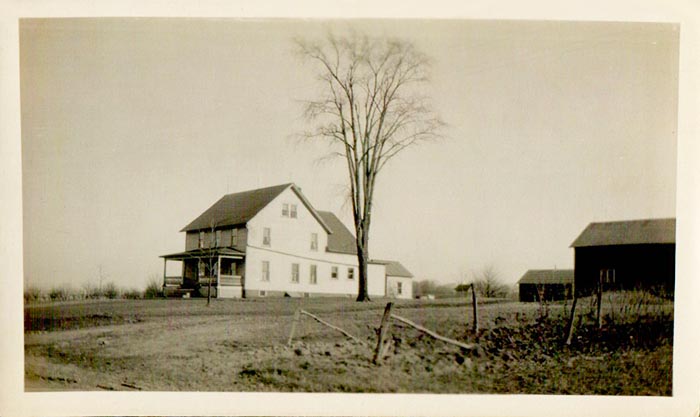
In May of 1903 Ransom purchased a majority of the Heirs of Warren Properties from Wilma and Daniel McGeean of 18 and 12 acres. This is our current Market and Jay built his barn in 1910 and the house a few years later (before 1917). This barn is the current Sage's Apple barn and market. Jay Minor Sage was on the Charter board of the Geauga Farm Bureau 4/14/1932.
Ransom continued to live in the house he built on the North side until his death in 1923 (speculation). At this time several Nye Family relatives resided on the farm and the house was rented to relatives for a few years. Jay M and Harriet Nye had one son before Harriet passed away in 1922. David Nye Sage was born in 1910 and as the story goes, probably he was born in the newly built barn. Jay M remarried Bertha King in 1924 and son Allen Ransom was born in 1925.
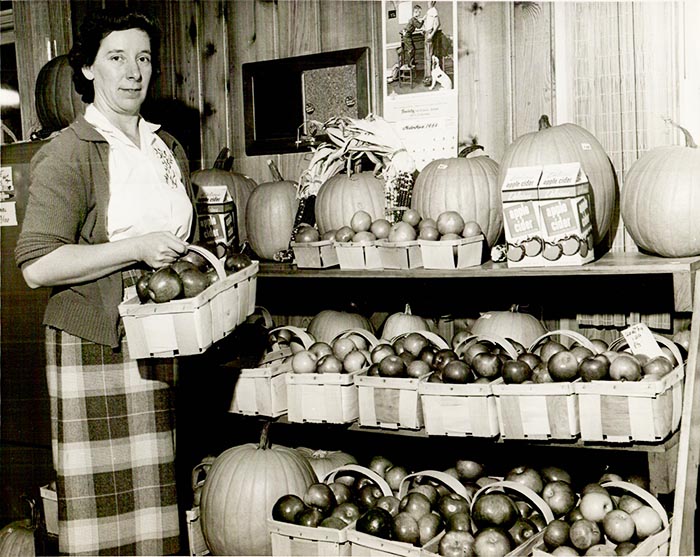
Allen spent about a year and a half in the U.S. Navy 1945-46 before finishing his education at The Ohio State University. He met Eleanor Timmons (from Auburn) and soon after they were married in 1951. Eleanor Sage was a Home Economics Agent in the early 50’s and judged the apple pie baking contest at The Great Geauga County Fair for many years. Eleanor and Allen Sage Lived and have raised their children in the current house with his parents Jay and Bertha. Allen and Eleanor had 3 children: Robert, John and Jayne. The farm with its fruit trees, cows, chickens and sheep continued into the 1950's
David N. reclaimed the original house on the North side of the street after college (speculation- Navy?) and married Margaret (Peggy) Heinbaugh. David N. and Peggy raised 3 sons: Lowell, Tom and Doug. David N. Sage was a Chardon Schools Board Member through the 1957 time when the present high school was built.
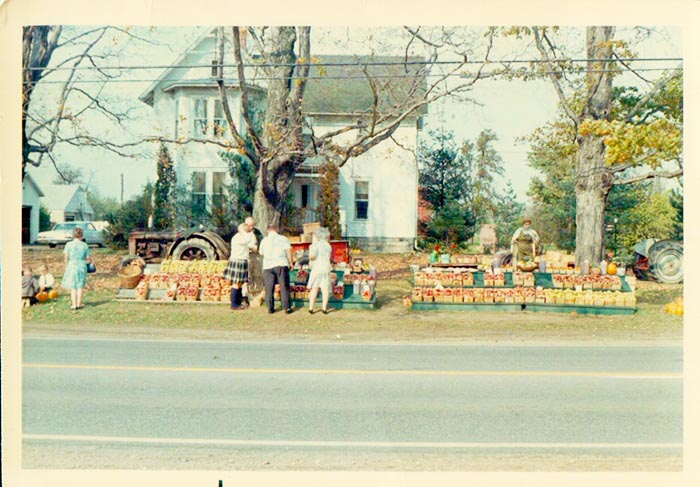
In 1957, the market moved from the table by the road into the remodeled stable, and a John Deere M took over for the 2 horses. Probably the deciding factor in making Sage's Apples what it is today occurred in 1952. Allen and Eleanor, recently married, had seen how good the Melrose apple was and decided to plant their first big planting of this variety recently developed at Ohio's Experiment Station (now O.A.R.D.C.). With 2 sons and a daughter coming along and farm sales increasing, more Melrose were planted in 1956.
Allen was a very forward thinker, as shown by his active participation in the Geauga County planning commission the Ohio Fruit Growers board of directors in the mid 70’s, (Robert A Sage was on the same board in the mid 80’s both 9 year terms which included President) and the Geauga Soil & Water Board, chairman at the time of his death in 1988.
On the North side of the road Eleanor and Allen Sage purchased 18 acres from the Parker Estate, which bordered the original 35 ½ acres, in December of 1960. So what did he plant in 1962? Melrose, of course, with a few Mcintosh, Golden and Red Delicious to satisfy those customers that hadn't tried Melrose yet! But by now he was also checking out other new varieties and rootstocks. The Transparent, Lodi, and Wealthy were proven summer apples but improvements were forthcoming with the advent of New York Fruit Testing Cooperative. NJ36 (Jerseymac) and NJ38 (Vista Bella) are two that have stood the test of time as has Paula Red for summer apples. The first Jonagold trees were planted in 1968 as were the first Spigold (made famous by being the active ingredient in the Sage's first blue-ribbon cider). Rootstock changes were in the making also. The first M9 trellis was planted in 1969 and is still front and center in the island between the two driveways in front of the market.
With John and Bob showing interest in the orchard business the orchard and market moved into an expansion mode. The present market was built in 1972 to give more floor space for additional crops as well as expanded jams, jellies, honey, popcorn, maple syrup and pancake mixes. This was about the time Farm Markets of Ohio, a merchandise and supply cooperative, was started by the Ohio Farm Bureau in Columbus and the ability to purchase and stock good quality items made this phase of the market easier to manage.
John and Bob graduated from OSU in the mid 70's and an outstanding relationship has continued with the land grant university research institutions to this day. Cultural and training systems have been tried and modified. IPM (Integrated Pest Managment) control strategies first used in 1970 are still being refined. Some of the first calcium research done in commercial orchards was done on some Sage Turley Winesaps and Spartans. Additionally sweet corn, 3 blueberry, raspberry, and blackberry varieties have been tried and accepted upon the advice and well-founded research performed by OSU research scientists. The first M9 trellis was planted in 1972. A few refinements have been made but it is the proven system with which to compare the newer varieties such as Gala, Ginger Gold, Fugi, Braeburn, and some numbered varieties yet to make a name for themselves.
In 1980 we built a new cooler to store apples through the winter and into the spring. This new cooler was designed for 18 bushel bins instead of the 1 bushel crates that were stacked by hand. This new cooler required a hydraulic forklift to stack 650pound bins of apples 6 high. The cooler capacity is 6,500 bushels of apples. We continue to use this cooler with only minor updates.
Each season has its attractions. Sweet corn, blueberries, peaches, red raspberries, and summer apples are the high point from July through September. Fall brings the beautiful fall color of the many maple trees in Geauga County as well as fresh apple cider, pumpkins, and as many as 20 kinds of apples to sample at one time. Christmas brings the gift box shipping season with many customers blessing their friends with boxes of apples or a "Geauga Box" containing apples, Fowlers Mill's pancake mix, apple butter and pure Geauga County maple syrup. Winter in Chardon is always an experience, but as the roads clear, each days business warms up and apple sales continue through Spring and into June.